Are the apocryphal gospels true?
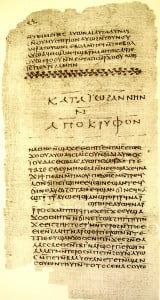 In recent year the 'apocryphal' 'gospels' accept been making something of a comeback. (I put the word 'gospels' in inverted commas, since these documents are not really in the grade of 'gospels'—on which come across below.) Perhaps the all-time-known of these is the Gospel of Thomas, a collection of 114 sayings attributed to Jesus which, every bit it happens, I read when I was a teenager. You lot tin can read it for yourself, along with other apocryphal texts, at the Early on Christian Writings website. Information technology was popularised by Dan Dark-brown's The DaVinci Code where is was presented as offering the hugger-mugger truth about Jesus suppressed by 'The Church' considering the truth was inconvenient for those with Power. What was less well-known was the actual content, which includes (in the last saying):
(1) Simon Peter said to them: "Let Mary go away from us, for women are not worthy of life."
(2) Jesus said: "Look, I will draw her in then every bit to make her male person,
and so that she too may go a living male spirit, similar to you."
(3) (But I say to you): "Every woman who makes herself male volition enter the kingdom of sky."
which doesn't look quite so liberating!
Aslope popular interest, there has likewise been growing scholarly interest in these documents, to the point where some have argued that Thomas should be considered alongside the four approved gospels every bit a historical source for Jesus. This is argued on the basis of an early on date for Thomas, which itself rests on a number of assumptions, including the idea that the earliest form of writing about Jesus took the form of collections of his sayings. However, many are now questioning whether such collections (including 'Q', the supposed other source with Marker behind Matthew and Luke) ever existed in circulation. The fact that Thomas appears to quote, parallel, or alluded to more than half of the documents in the New Testament would suggest it is no earlier than 150.
Orthodox critique of the counterfeit writings has tended to residual on just such arguments—that they are tardily, and have relatively poor manuscript attestation, and so should not be considered historically reliable accounts to rival the canonical gospels. But suppose Thomas was early, or went back to an early on tradition? And nosotros would not expect to find many manuscripts, given that they were ordered to be destroyed by church leaders similar Athanasius. At the British New Attestation Conference terminal weekend, Simon Gathercole highlighted these bug in the terminal plenary paper. He noted a number of criticisms of the traditional position which raise questions most a elementary, historical statement.
If we go dorsum to the primeval known sources of Christian tradition – the sayings of Jesus (although scholars disagree on the question of which sayings are genuinely authentic), nosotros can encounter how both gnostic and orthodox forms of Christianity could sally as variant interpretations of the teaching and significance of Christ. (Elaine Pagels, The Gnostic Gospels p 148)
We often assume a kind of natural continuity betwixt Jesus and the synoptic tradition's version of what Christianity is all about. Simply amidst the primeval followers of Jesus in that location were clearly other ideas about the meaning and significance of what he said and did…Thomas shows that the synoptic construal of these sayings is not necessarily natural. They could accept been, and were, taken in quite a dissimilar direction in Thomas Christianity. So who was right about Jesus? Was it Mark? John? … Thomas? (Stephen Patterson, 'The Gospel of Thomas and Historical Jesus Enquiry', 138-139)
These gospels all claim churchly say-so, and they all present an prototype of Jesus rooted in early tradition and shaped past later interpretative developments…Information technology would be hard to argue on neutral exegetical grounds that differences between the Synoptics and Thomas are more than cardinal than differences between the Synoptics and John. (Francis Watson, Gospel Writing, 341 and 370)
What these three critiques suggest is that the historical argument might non be so convincing. The question might exist less whether Thomas and the others are historically reliable, only whether they present a true interpretation of the historical facts. Is in that location, contrary to Watson, something that sets the canonical gospels apart from the counterfeit ones? An answer was given to this some fourth dimension agone by Richard Burridge, Dean of King's Higher London, in his What are the Gospels?Burridge demonstrated, by statistical assay, that the approved gospels behave all the hallmarks of a first century 'life' focus on the subjects life, significant deportment and death. When I asked if he had ever done the aforementioned analysis on the counterfeit documents, he immediately commented 'There would exist no point—they are so vastly different.' That is why Tom Wright argues that these documents should non even exist called 'gospels' since they lack the narrative framework of the canonical gospels.
 Gathercole offered a different, but equally compelling, analysis, focussing on the theological content, rather than genre, of the gospels. His argument was presented in ii stages. Showtime, he proposed that the apostolic announcement of the gospel function equally a kind ofregula fidei,a dominion of organized religion, which shaped the formation of the New Testament. This 'dominion' tin be found in 1 Cor xv.3–4:
For what I received I passed on to yous every bit of starting time importance: that Christ died for our sins co-ordinate to the Scriptures, that he was buried, that he was raised on the third twenty-four hour period according to the Scriptures…
This pattern of proclamation tin exist found elsewhere in the NT (for example, in Heb x, 1 Peter 1.ten–11, in the Book of Revelation) and at that place is practiced evidence that Paul was correct in describing it as an established tradition of teaching. It includes the following four elements:
1. Jesus was the 'Christ', the i anointed by the Creator God of Israel
ii. That his life was, in some sense, a 'fulfilment' of the Jewish Scriptures
three. That Jesus' death dealt with the problem of sin
4. That he was raised on the 3rd solar day.
Gathercole then took each of these items in turn, and explored how meaning they are in the canonical gospels, and how significant they are in each of the seven best-attested apocryphal 'gospels'—the Gospel of Peter, the Gospel of Truth, the Gospel of Thomas, the Gospel of Philip, the Gospel of Mary, the Gospel of the Egyptians (Coptic, NH) and the Gospel of Judas. His analysis highlighted two things:
- Outset, whilst the canonical gospels explore and limited each of these 4 ideas in their own distinct mode, which some significant variation, they were all clearly present and of cardinal significance in each gospel.
- 2nd, by contrast, there was not a single counterfeit document in which all four of these ideas were nowadays, and none of the four was present across the seven apocryphal documents. At that place is, in fact, little in common between the seven; they show widely different levels of interest in each of the four themes, and pass up them in unlike means.
For instance, the idea of Jesus being 'the Christ' is rejected past the Gospel of Judas; the championship is given new content, distancing information technology from the creator God of Israel in the Gospel of the Egyptians, the Gospel of Truth and the Gospel of Philip; and the title is simply not present in the Gospels of Thomas, Mary and Peter.
These findings practice ostend the mutual and instinctive sense that the apocryphal documents are quite different from the canonical gospels. At one level, this does non put to an end the 'conspiracy theory' that certain views were suppressed—there was clearly some variety of view, and the conspiracy theory needs to be addressed in other means, by taking seriously the historical context of the early followers of Jesus. They were non powerful; they were persecuted for centuries; and in that location was no institution to defend.
But the session did brand me think over again most contested bug of history. historical events can exist interpreted in different ways, and the claim that we take in the approved documents is notsimply that these things happened, justbesidesthat this is their truthful pregnant.
If you detect this blog of value, would you considerbecoming a patron to support my work?
If you enjoyed this, practice share it on social media (Facebook or Twitter) using the buttons on the left. Follow me on Twitter @psephizo. Like my page on Facebook.
Much of my piece of work is done on a freelance basis. If you lot accept valued this post, you tin can make a single or repeat donation through PayPal:
Comments policy: Good comments that engage with the content of the post, and share in respectful debate, can add real value. Seek kickoff to understand, and so to be understood. Make the most charitable construal of the views of others and seek to learn from their perspectives. Don't view debate equally a conflict to win; address the statement rather than tackling the person.
pritchardyesposiond62.blogspot.com
Source: https://www.psephizo.com/biblical-studies/are-the-apocryphal-gospels-true/
0 Response to "Are the apocryphal gospels true?"
Post a Comment